This is a (lightly) edited version of two articles about the staff of Alfred Hitchcock’s Mystery Magazine. They appeared in The Palm Beach Post-Times in the 1960s.
A major national magazine published in Florida? It can’t be done, they said.
“Why not?” mused Richard E. Decker, a publisher of several magazines in New York.
New York is where magazines are published. Anyone knows that. Oh, some rare ones may be done in Boston, Philadelphia, or Chicago, and some regional and religious ones may originate in other cities.
But Riviera Beach? REALLY!
However, Richard Decker had been coming to Florida every year, and he saw no reason he couldn’t move himself, his wife, and his pet magazine to the Gold Coast to set up shop.
And so, hidden away behind an attractive but non-committal facade in Palm Beach Shores is the very successful Alfred Hitchcock’s Mystery Magazine. And while other mystery magazines come and go, dying within months of their birth, the Hitchcock goes merrily on its way, year after year. It’s now in its 13th year of publication, 8 of which have been spent in Florida.
’The surroundings are perfect for our publication,” says Decker, who established the periodical in New York in 1956 and brought it to Florida’s Gold Coast in 1959.
“We first based the office in North Palm Beach and later moved it to the island. Our whole Southern relocation just seemed natural since my family and I had been vacationing in the Palm Beaches for a number of years. We decided to try this sunshine full-time and here we are.”
The editor explains that unlike most mass circulation magazines, his is not bound to the nucleus of the publishing world — New York.
“Our printing, which is done in Concord, N. II., is the only thing we left up North,” says Decker. “All editorial work is centered here. We handle stories, writers, literary agents and subscriptions through the mails.” The fact that the publication runs no advertising gives it even greater freedom from New York, where magazines usually most do business with clients’ agencies.
“We have numerous advantages here,” says Decker. “We can work in peace and quiet, and it is almost impossible to do this in a big city, where writers, visitors and others form a constant parade through your offices. No such problem here. Must local people don’t even know where we are. Interruptions are few.”
There are many other features to the magazine’s Florida locale, says the editor. Sunshine, the ease of travel and the Atlantic — which the staff can view between mysteries — are at the top of the list.
Having worked in the East and been victims of bitter winters and agonizing commuting, the staff members especially value these offerings but say that Decker gets the prize in the appreciation department. He often walks to and from work, taking in sun and surf in route.
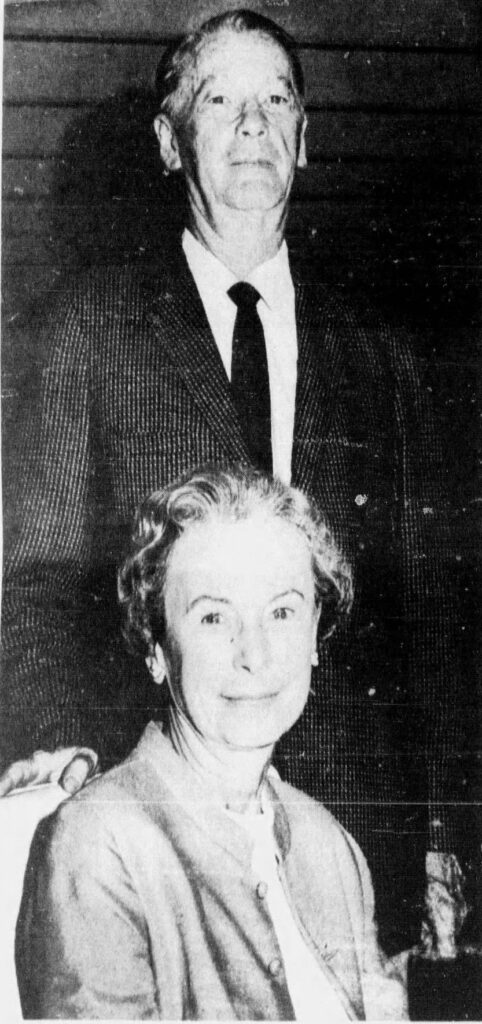
In pleasant relaxed offices that belie the amount of work going on, Richard and Gladys Decker, along with editor Ernest Hutter, turn out the monthly magazine of suspense stories that not only is distributed to 300,000 persons in the United States, but also goes into 40 different countries and is reprinted in 6 languages.
“We have a Spanish edition for Spain, one for Mexico, and one for Argentina,’’ smiles Decker. Apparently Mexican slang or Argentinian idioms are not interchangeable! The cover of the French edition is easy to spot — it features busty women rather than the portly Mr. Hitchcock! He does not publish abroad but sells the magazine’s rights to foreign companies.
The growth of the publication, Decker says, has been sparked, of course, by the Hitchcock television program, which is shown in many distant lands.
Surprisingly, the master of suspense has little to do with the magazine. “His name is certainly one of our big attractions,” says Decker, “but he has no direct connection with the actual production of the publication.”
Hitchcock’s daughter, Patricia Hitchcock O’Connell, is the only liaison between her father’s Hollywood offices and the magazine, which has titled her associate editor.
The Hitchcock representatives, who see first proofs of the magazine, have first rights to any of the short stories for use on TV. Stories that are selected for TV presentation are usually given to Joan Harrison, a producer of the TV series, and are then adapted to video.
“We get 2 or 3 persons a month who track down our offices, and come to the door, hoping to meet Hitchcock and talk to him,” laughs Hutter. “They’re convinced he writes the whole magazine, and they’re very disappointed not to see him here.”
“Ours is one of the best markets for mystery writers,” explains Ernest Hutter, who has been editor of the magazine for the past 3 years. “We pay well and we respond promptly, so we usually get first choice.”
Hutter started out as a crime writer himself — first in Cleveland and then in West Palm Beach as a court and crime reporter. He is a former city editor of The Palm Beach Post- Times. In 1963 he was the author of the highly successful paperback book The Chillingworth Murder Case, published by Monarch.
Stories for Alfred Hitchcock’s Mystery Magazine, however, are fictional, not based on actual crimes.
“Plot, presentation, and the quality of the writing determine acceptance or rejection of stories,” explains Decker.
“We don’t use stories that rely on bloody violence, racial prejudice, profanity, perversion, sex, drugs, or cheap sensationalism,” puts in Mrs. Decker, who is as deeply involved in the magazine as her husband. “Good writers don’t really need that sort of thing. It’s usually a sign of incompetence.”
Of the 15 or so stories used in each month’s edition, all but one or two are bought from agents and regular contributors. To select the 15 stories, they must read some 50 agented submissions and 450 unsolicited manuscripts — known in the trade as the ‘‘slush pile” — each month.
To help him find those new talents, Decker has a staff of four at his Palm Beach Shores office. The unusual pops up again. The staff is a husband- and-wife arrangement. Joining Decker is his wife, who is managing editor; Ned Benham and his wife, associate editors. Marguerite Blair Deacon, art director, who illustrates the magazine completely, does her work at her Lantana home.
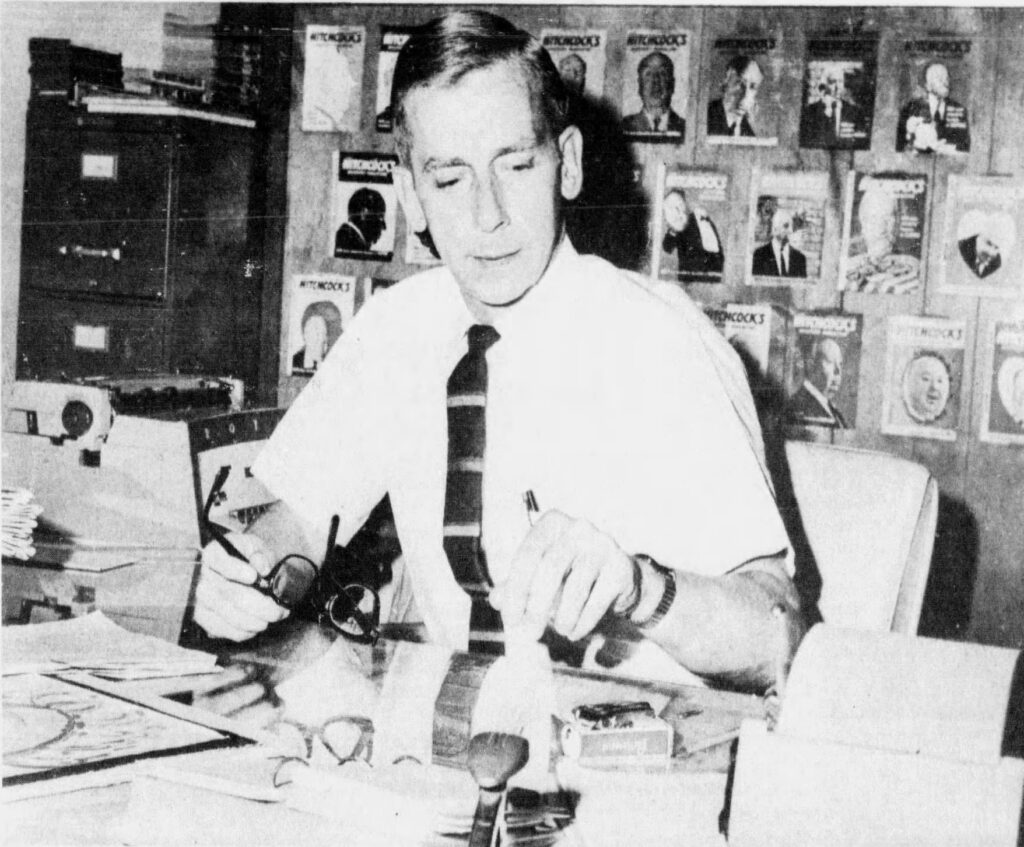
The story of the Dockers’ and Benhams’ union is quite a twister in itself. Mr. Decker and the Benhams, all veterans in the publishing business, were employed by Macfadden publishing company, and Liberty Magazine at the same time, frequented the same offices but did not discover one another until they came South.
What sells them on a story?
“We look for interesting characters first, and then an intriguing, plausible plot,” explains Hutter. That the stories selected are good is indicated by the fact that they frequently end up as TV dramas. “Unfortunately, many of our most reliable authors desert us to write exclusively for television,” laments Hutter.
“Once an author has sold to us, of course, he moves out of the slush pile and into the select pile with his next submission,” adds Decker.
Who writes mystery stories? People from every walk of life.
“Doctors, housewives, teachers, people in the legal profession, a policeman’s wife, full-time writers, ex-cons…” says Hutter.
“The ex-cons are great,” laughs Decker. “They really know what they’re writing about! We’ve even got one who seems to be an expert on the Mafia. Right now we have a writer who was a first class bank robber — till he got caught. He sends us a story a month, from Leavenworth. They’re censored, of course, and he can only have one out at a time.”
“We have quite a few Florida writers submitting lately,” puts in Hutter. “There are a number in the Sarasota area, for example. And Ted Pratt writes some mysteries for us.”
Although women make up a large per cent of the magazine’s readers, they don’t contribute as many of the stories. “One or two a month, on the average,” Hutter estimates, adding, “yet, some of the best stories are by women.”
“There are always at least 6 magazines in various stages at any given time,” smiles Gladys Decker. “Besides the one on the stands, there’s one ready for distribution, one at the printer in New Hampshire, one in page proof, one in galley proof, one at the artist — that’s Marguerite Blair Deacon, a Palm Beach County free lancer — and one being made up.” She smiles serenely as if it were no problem at all to juggle these hundreds of stories.
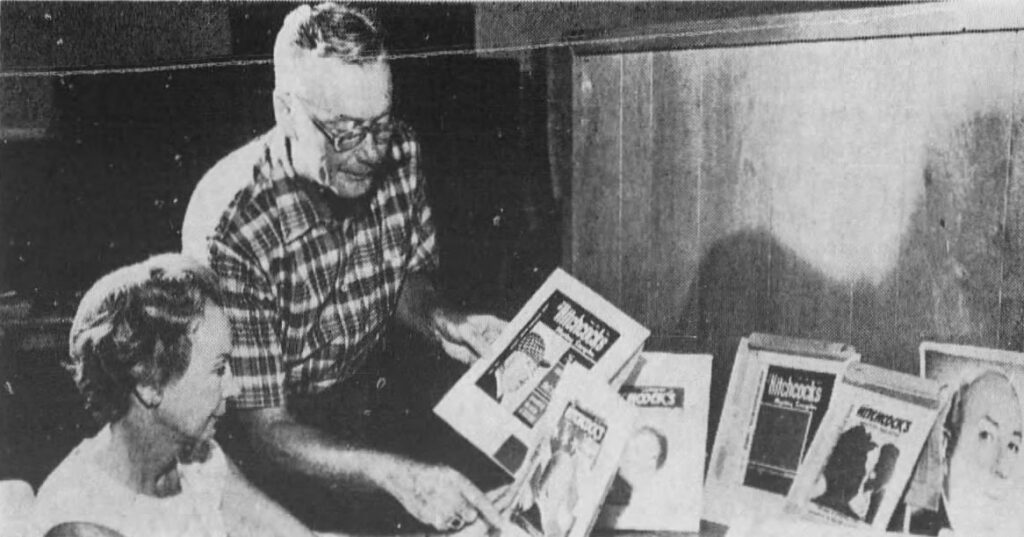
“A story we buy today won’t appear until a year from now,” puts in Hutter.
One thing is certain — even Hitchcock would have a hard time concocting anything more unusual and more unexpected amid swaying palms and sunshine.